Giorgio Savastano
When a coarse description predicts better than the complete state, and when it doesn't.
View the Project on GitHub giorgiosavastano/predictive-abstraction
The Art of Forgetting: From Borges to a Hypothesis About Intelligence
By Giorgio Savastano, PhD · Background and experience · Publications
When data and time are limited, can a machine learn to predict a system better from a useful set of abstractions than from every available detail?
As humans, sometimes we can remember every word of a conversation and still miss its point. That gap between having information and understanding is what fascinates me here, especially when we talk about intelligence in machines.
Let me take you on a short journey through some ideas borrowed from literature, philosophy and physics, down to a small hypothesis we can actually test.
6 November 2026. Code, raw results and the research note are in the repository. The README explains how to reproduce the experiments and figures; a one-minute demo is also available there.
1. The man who remembered everything
In 1942, Borges wrote a story that has stuck with me for more than 20 years. The story is about a young man in Uruguay, Ireneo Funes, who falls from a horse and wakes up with superhuman memory, which allows him to recall the shape of clouds at any given time, geometric forms of a changing flame, and essentially every single detail of his life. What may sound at first like an incredible gift is quickly revealed to be a diabolical curse, as Funes is unable to disregard useless details and struggles to generalize or form abstract concepts. When Funes sees a dog, he is so fixated on every detail that he finds it hard to accept that it is the same dog he finds a few seconds later.
From this first story, I want you to take home the importance of forgetting, of compressing information down to useful abstractions.
2. Information is not understanding
The year before, Borges wrote another story, called The Library of Babel. This story has recently been mentioned in connection with the wave of AI-generated content flooding the internet. The story is about a library that contains all possible books of 410 pages, created by forming all possible combinations of a fixed set of characters. In that sense, this imaginary library contains every book that has been or will ever be written in those characters: longer books could be divided across several volumes. It contains all useful knowledge, from a cure for cancer to the origin of the universe. However, it also contains a huge amount of nonsense, contradictions and misleading claims. It contains proofs, absurd claims and everything in between, including arguments for everything and the opposite of everything. The fictional people living in this strange universe quickly abandon their original excitement at the thought that they could find any information they might need, and fall into a state of despair fed by the fact that all this information is effectively unusable and their search is pointless.
Here we are going to borrow the distinction between the existence of information and its accessibility.
3. Abstraction and compression in physics
There is a recent video by 3Blue1Brown, Reinventing Entropy exploring the mathematics of compression as part of a series connecting it to how AI systems learn. The thought-provoking and attention-grabbing idea behind the series is that intelligence is compression. My idea is somewhat adjacent to this one, as finding abstractions can be seen as an information compression process: ignoring what is not useful and keeping only what is. We find examples of these useful compressions everywhere in the laws of physics that we use to describe reality and solve specific problems. My favourite example is in thermodynamics, where, instead of following the evolution of billions of molecules of gas, we can simply keep track of 3 numbers, T, P and V. For a fixed amount of a simple gas of known composition, these are enough to describe its macroscopic equilibrium state. For an ideal gas, the equation of state relates them, so only two are independent once the amount of gas is fixed.
So here we start seeing clearly an important caveat: these abstractions may be task dependent, meaning they may be good for describing specific problems and may not necessarily be enough for every situation.
4. What if intelligence works similarly?
Put the three stories together and a working hypothesis suggests itself. Perhaps one important component of intelligence is recognizing the level of description at which a complex system becomes easiest to understand. A system that does this, when it meets a new situation, figures out quickly which details matter for what it is trying to do, builds a description that keeps those and drops the rest, notices that the description it built resembles one it has used before, and abandons it when it stops working. Not compression for its own sake, but abstraction: compression that preserves the relationships that make the information useful. And, if the physics is any guide, the relationships worth preserving are often the ones emerging from the system.
5. From the idea to a test
To investigate this idea, we need to distinguish between finding a useful set of abstractions and using them. Here, I start with the second question: can a model learn from a useful set of abstractions without having to find them for itself?
There is another question behind the physics example. Some useful descriptions reflect collective behaviour produced by the system itself. This is the sense of emergence that interests me here. Pressure comes from many molecules interacting; it is not a property of one molecule. Therefore, some emergent properties of the system may be useful things to capture in an abstraction. However, as we will see, it always depends on the questions we are asking about the system.
I find related motivation in Michael Levin’s work on development and regeneration, where he discusses goal-directed behaviour in groups of cells, and in Cavagna, Parisi and colleagues’ measurements of starling flocks, where correlations in the birds’ velocities extend over distances that grow with the flock. These are different kinds of evidence about collective behaviour. I am borrowing a question from them: when does looking at the group reveal something useful that is difficult to see by looking at its parts separately?
Before testing whether a system can discover, reuse or adapt an abstraction, I wanted to start with a simpler question: if I supply a good abstraction, how much does it help?
The experiments led to three observations. A summary I designed helped the model predict the overall recovery of the system using less data and computation. But the full state became more useful when I asked a different, local question. And a separate test suggested that a few global variables captured much of the system’s average recovery behaviour.
6. A small experiment
For this I built a world where I can control the rules and repeat the same situation many times. Start with an array of 64 numbers, from 0 to 63, in sorted order. Scramble a chunk of it, sometimes two. Then let neighbouring numbers compare and swap if they are in the wrong order. One round, or sweep, checks the alternating pairs in two phases, so each comparison is local. Swaps sometimes fail, and one region has less reliable exchanges than the rest. After twelve rounds, how much disorder will be left?
Here disorder has a simple meaning: how far each number is from its correct position, averaged over the array. If every number is home, it is zero. The setup is inspired by the self-sorting arrays studied by Taining Zhang, Adam Goldstein and Michael Levin. My simulator is much simpler and is not a replication of their experiments or a model of biological intelligence.
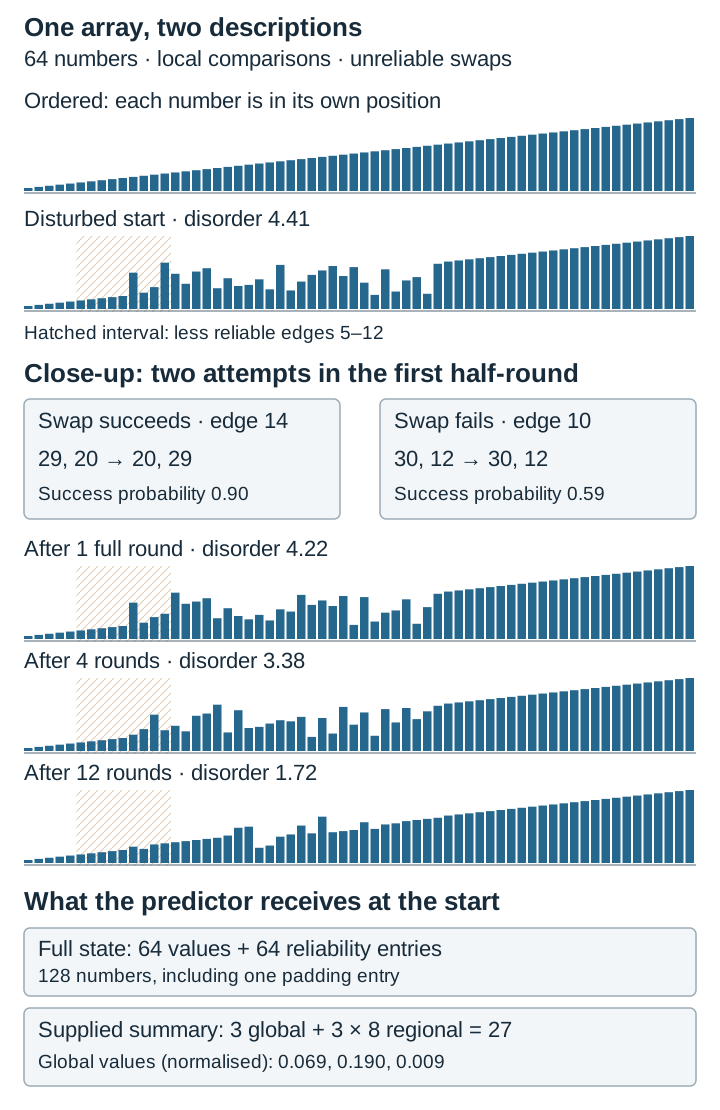
One configuration, generated and evolved by the simulator. Each column is a position and its height shows the number there. The shaded interval has less reliable exchanges. The close-up shows the first half of one round; a full round checks both sets of alternating pairs. This is one possible recovery, not an average over futures. Open the diagram for a larger view.
Because each swap attempt can succeed or fail probabilistically, the same starting state can have different futures. Therefore, even a predictor that knows the exact average remaining disorder after twelve rounds will make errors on individual runs because of this randomness. To estimate this error floor, I kept the initial ordering and swap probabilities fixed for each starting configuration in the test set, then simulated 32 independent futures. This allowed me to estimate how much the remaining disorder varies purely because of randomness. Combining that variation across the test set gives an estimated floor of about 0.19 positions per element, measured as root mean squared error, or RMSE.
I trained the same kind of machine-learning model, gradient-boosted decision trees, on three descriptions of the starting state:
- The full state: all 64 values and the exchange reliabilities, stored as 64 numbers, including one padding entry. This gives 128 numbers in total.
- A summary I designed: three global numbers describing average displacement, the fraction of neighbours out of order, and the overlap between displacement and unreliable exchanges. I also divided the array into eight regions, and for each of them I kept average displacement, the fraction of neighbours out of order, and average exchange unreliability. This gives 27 numbers.
- Random combinations of the full state: 27 numbers again, but constructed without knowledge of the sorting task.
I also used the initial disorder alone as a one-number reference, and checked what happened when the full state and the designed summary were supplied together.
The second description contains quite a lot of my own knowledge. I already know the desired ordering, and I know that faults slow the recovery. I compute these summary numbers before training and hand them to the predictor.
Each training example pairs one starting configuration and its swap probabilities with the remaining disorder measured after twelve rounds. I repeated the comparison ten times, using a different random seed each time to generate fresh training, validation and test examples. Training budgets ranged from 250 to 5,000 examples. There were three model sizes at every budget and a fourth, larger one at 5,000 examples for the global task. Each description could select its own model size using a separate validation set. The test examples were kept out of that selection. The methods give the full protocol.
7. What the results show
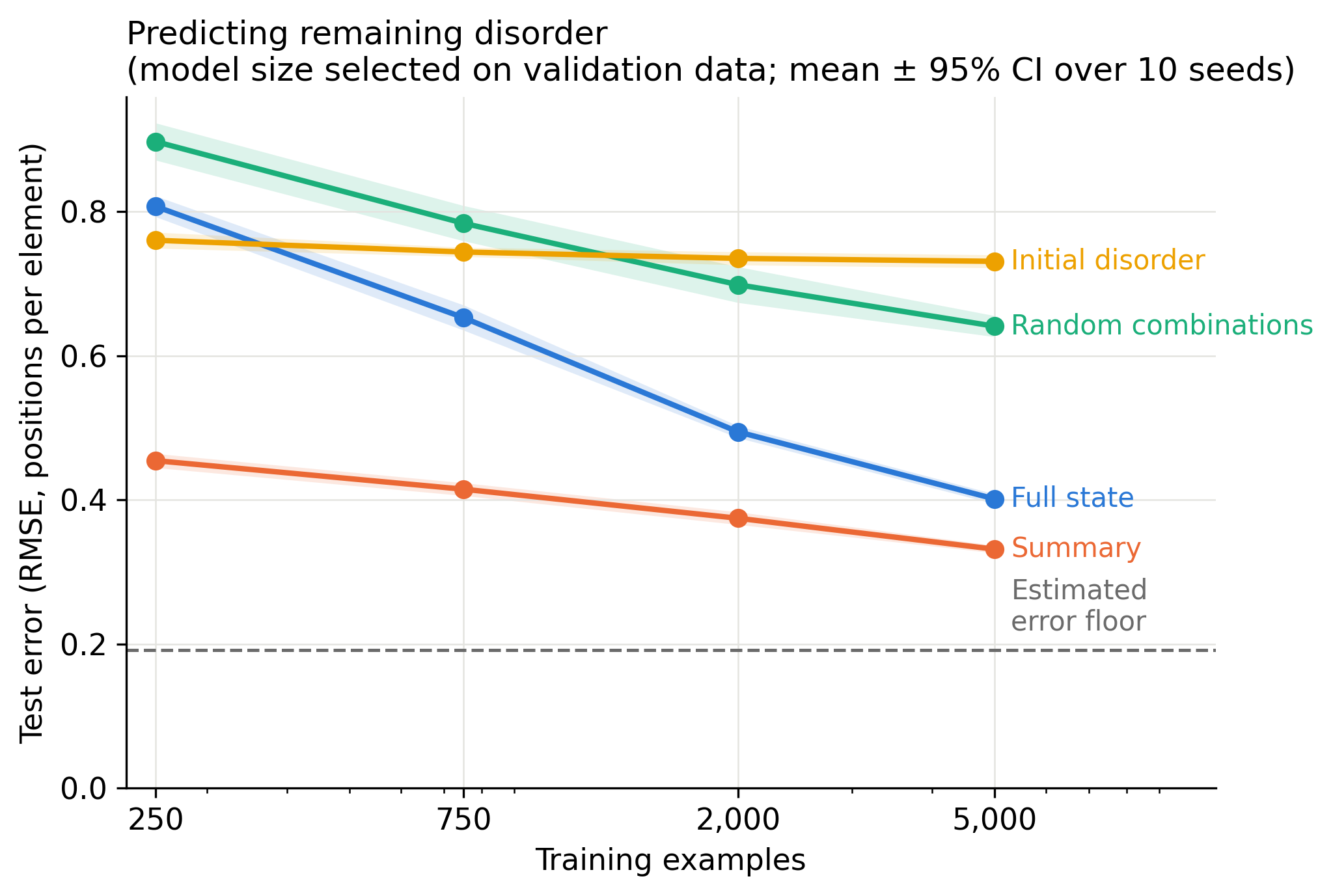
In this figure, the orange line represents a predictor trained on the summary, and the blue line one trained on the full state. The green line uses random combinations, while the yellow line uses initial disorder alone. Moving to the right gives each predictor more training examples.
The carefully engineered summary beat the full state at every tested model size, especially with fewer training examples. With 250 examples, its error was 0.455 against 0.807 for the full state. However, the full state is catching up fast as we increase the number of examples. At 5,000 examples the errors were 0.332 and 0.401. The figure uses a model size selected separately for each description on validation data. These are averages over the ten seeds; the shaded regions show 95% confidence intervals.
What I take from this is that the summary helps most when the learner has access to fewer training examples. Since I compute the summary from the full state, it cannot contain extra information about the target. That does not guarantee that this particular predictor will eventually find the right summary, or that the summary I provided is the optimal one. The predictor could find a better one.
There was also an important practical difference in computing time. At 5,000 examples, a medium model with access to the summary reached an error of 0.366 in about 0.31 seconds, while a large model with the full state reached 0.401 in about 4.06 seconds. That is about one-thirteenth of the measured time, including feature extraction, fitting and test prediction on the same machine. However, this does not include the human effort and time needed to design the summary.
The random combinations did worse than both the summary and the full state at every tested budget and model size in this experiment, on average. At 250 examples, they were even worse than using initial disorder alone. Simply reducing the number of inputs did not reproduce the benefit. Adding the full state to the designed summary did not improve the average error either.
Next, I varied the number of regions from 1 to 64, using the same configurations for each comparison.
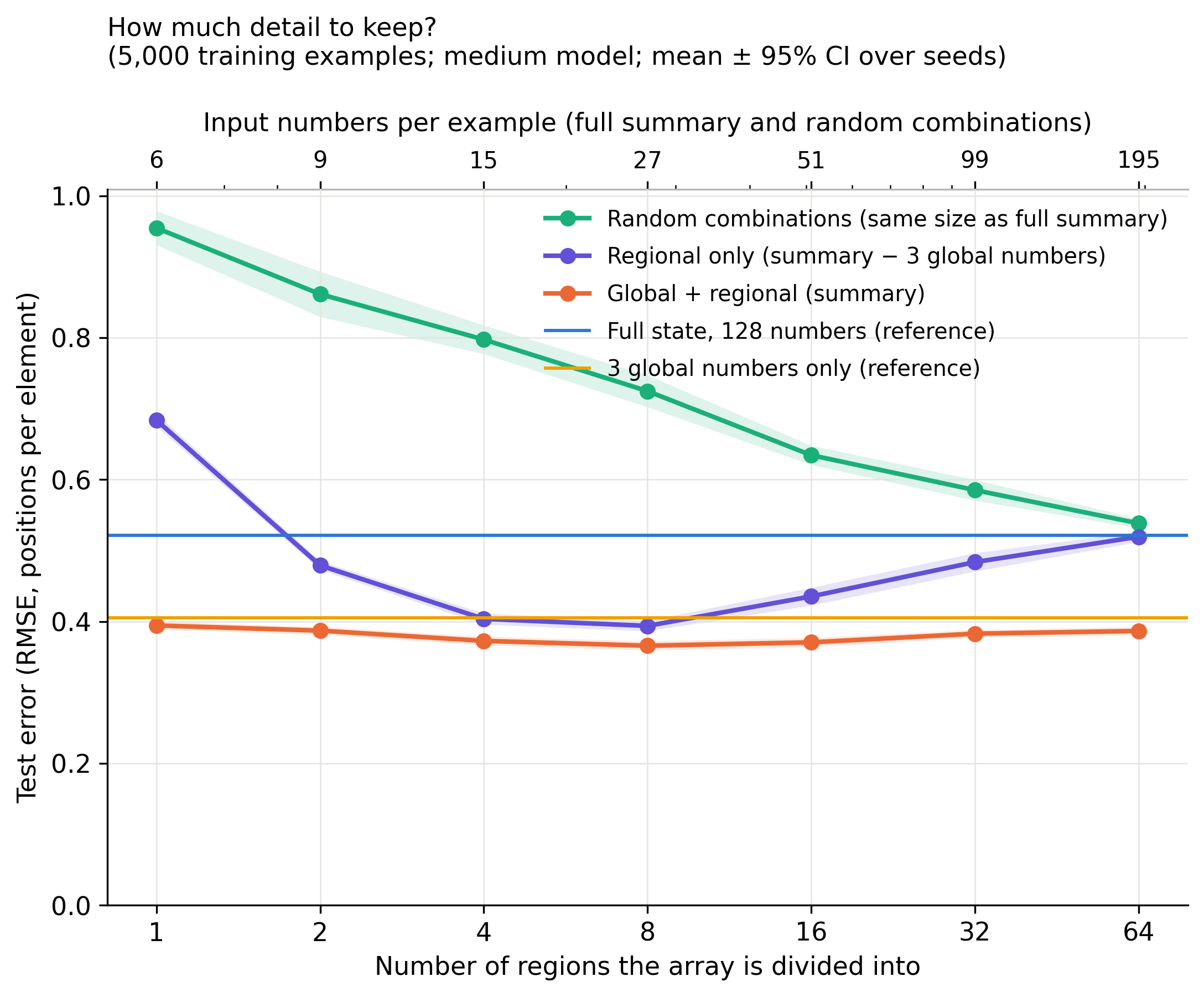
Here I kept the model size fixed and trained on 5,000 examples. Each line uses a different description of the same configurations: the orange line uses the full summary (3 global numbers + 3 numbers per region), the purple line uses only the regional numbers (3 numbers per region), and the green line uses random combinations of the full state, with the same number of inputs as the full summary. The horizontal blue and yellow lines represent the full state (128 numbers) and the 3 global numbers alone.
The upper axis counts input numbers per example for the orange and green lines. With 8 regions, that means 27 numbers; the purple line uses 24.
One thing that is immediately clear is that most of the benefit was already present in the three global numbers. A predictor with access only to these 3 numbers (yellow horizontal line) already reached 0.405. Adding regional detail helped, but the full summary’s error changed relatively little across resolutions.
Interestingly, when I kept only regional statistics (purple line), four to eight regions did much better than sixty-four. There seems to be a trade-off between losing useful detail and giving the learner too many quantities to fit.
The research note gives the detailed comparisons across training budgets and model sizes.
Then I changed the objective of the predictor: it now has to predict which number will be at the centre after one round of sorting.
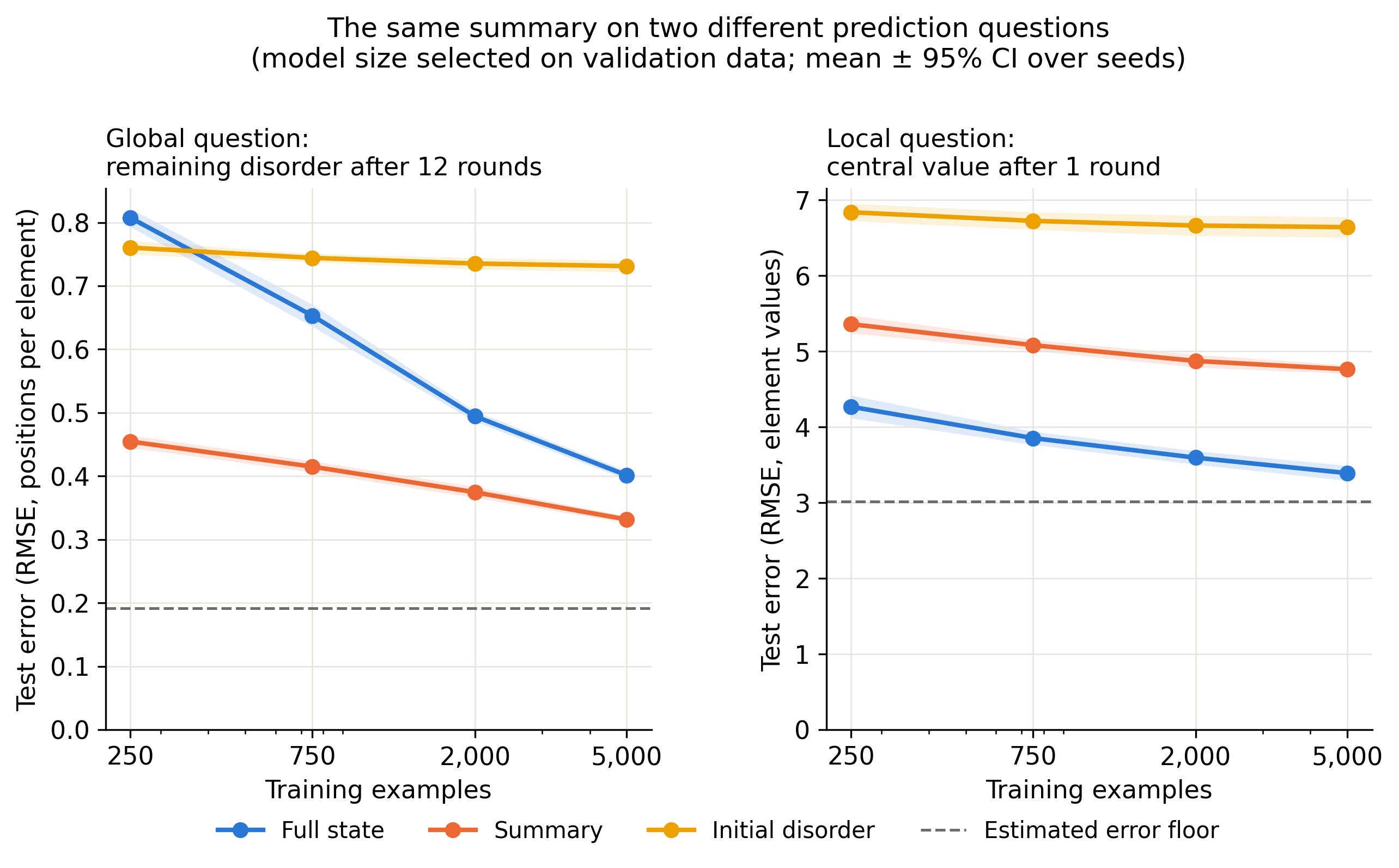
In this figure, the left panel repeats the global question about remaining disorder, while the right panel shows the new local question. The blue and orange lines represent the full state and the summary. On the right, their ranking is reversed: the predictor with access to the full state makes smaller errors.
The full state now beat the summary in all ten seeds, at every tested budget and model size. For example, at 5,000 examples with validation-selected model sizes, its error was 3.39 against 4.76. These errors concern element values, rather than the average displacement used in the global task. Finer regional descriptions generally helped, but even the sixty-four-region description reached only 4.15. It still omits explicit element identities and displacement signs.
This brings us back to the caveat in the physics example. The summary was built for a question about the whole array’s recovery. It leaves out detail that matters for a question about one particular position. Better predictive learning with that summary does not by itself show understanding, or intelligence.
The Experiment 1 results and Experiment 2 results include the full comparisons and uncertainty estimates.
8. Does the summary capture something about the system?
There is still a question left from the discussion of emergence. Did I just find convenient inputs for decision trees, or do these collective variables capture something meaningful about how the array evolves?
To investigate this, I ran a separate experiment without training a learner. I compared thousands of arrays with similar global summaries but different microscopic arrangements, and simulated multiple possible futures for each. The question was simple: if two arrays look similar according to the summary, will they also recover in a similar way?
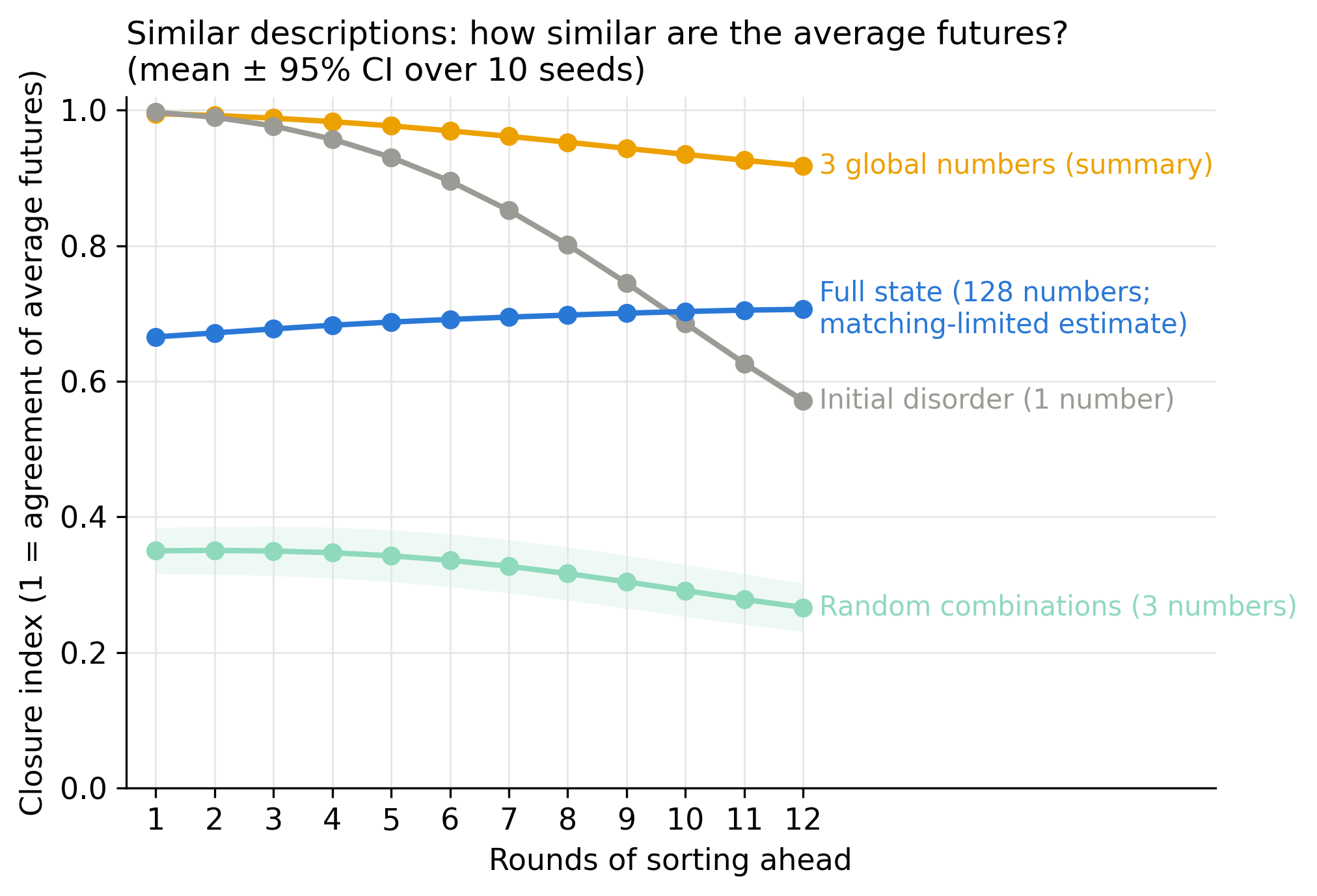
The results were encouraging. Twelve rounds ahead, the three global numbers reached a closure index of 0.918, where 1 means perfect agreement between the estimated average futures of matched configurations. Initial disorder alone reached 0.572, while three random combinations of the full state reached only 0.266.
Interestingly, the full microscopic state scored worse than the three global numbers. But this doesn’t mean that compression somehow creates information. Matching configurations on 128 numbers is much harder than matching them on three, so this is a limitation of the matching method.
What I take from this is that the three global numbers seem to capture much of the collective recovery behaviour of the array, at least for the configurations and time horizons tested here.
However, this experiment only compares estimated average futures, not the full range of possible outcomes. It doesn’t establish that the macroscopic variables form an autonomous dynamical system or demonstrate causal emergence. The Experiment 2b results explain the method, its limitations, and the additional tests in detail.
9. The art of forgetting
The local prediction result makes me cautious about turning Funes into a simple argument for forgetting. Sometimes the detail is what the question needs. The ability I am interested in is choosing what to keep, and recognizing when that choice needs to change.
Ted Chiang explores a related problem in The Truth of Fact, the Truth of Feeling. A technology makes recorded experiences searchable, and the narrator finds that a memory important to his understanding of himself is wrong. I read this as another way of approaching the distinction between a record and what we make of it. A better record can correct us; making sense of it remains a separate task.
This is also why I find the physics example useful. We can work with a macroscopic description while keeping access to finer detail when the question requires it. Perhaps part of intelligence involves learning to make that choice, recognizing a useful relationship in a new setting, and revising the description when it fails.
For now, the result is smaller than that hypothesis. In this sorting system, a summary designed with knowledge of the task helped one kind of learner predict global recovery with less data and computation. The same summary worked worse for a local question, and a separate test found that configurations with similar global summaries tended to have similar average futures. Whether a system can discover such descriptions for itself, transfer them and adapt them is what I want to investigate next. I also want to know whether the effort of discovering a summary can pay for itself in later predictions.
To reproduce the quick experiments, run uv sync, then uv run macro-experiment1 --quick, uv run macro-experiment2 --quick and uv run macro-experiment2b --quick. These use two seeds; they do not reproduce the full ten-seed results quoted here. The README gives the full commands, timing context and analysis step for rebuilding the tables and figures. The research note contains the detailed results and limitations.
Sources and further reading:
- Literary sources: Borges, “Funes, His Memory” (1942) and “The Library of Babel” (1941), in Collected Fictions (Penguin, 1998); Ted Chiang, “The Truth of Fact, the Truth of Feeling,” in Exhalation (Knopf, 2019). These are starting points for interpretation, not scientific evidence about memory or intelligence.
- Compression: 3Blue1Brown, Reinventing Entropy, Part 1 of the compression and intelligence series. For the mathematical connection between predictive models and lossless compression, see Delétang et al., Language Modeling Is Compression.
- Learning and abstraction: Tishby, Pereira & Bialek, The information bottleneck method; Chollet, On the measure of intelligence; Gentner, Structure-mapping (1983); Abel, A theory of abstraction in reinforcement learning; Ho et al., People construct simplified mental representations to plan (2022).
- Collective behaviour: Zhang, Goldstein & Levin (2025); Cavagna et al., Scale-free correlations in starling flocks (2010); Levin, Technological approach to mind everywhere (2022).
- Coarse descriptions and prediction: Shalizi & Moore, What is a macrostate?; Israeli & Goldenfeld, Coarse-graining of cellular automata, emergence, and the predictability of complex systems (2006); Crutchfield, Between order and chaos (2012). On the separate debate about causal emergence: Hoel (2017) and Eberhardt & Lee (2022).
For a broader philosophical motivation, Demis Hassabis describes his conjecture that information is more fundamental than matter and energy. Our sorting experiments do not test that conjecture.
About the author
I’m a remote sensing scientist with a PhD in geodesy and geomatics from Sapienza University of Rome. At Spire, I work on turning satellite measurements into estimates of physical quantities such as soil moisture; before joining Spire, I held a NASA Postdoctoral Program fellowship at the Jet Propulsion Laboratory.